Recent Post
- 2026-06-04 03:38:40
- 2026-06-02 12:57:03
- 2026-02-04 07:21:51
- 2026-01-21 03:39:14
- 2026-01-14 02:33:37



Abstract — Automatic tool change (ATC) has migrated from the machining-center world into the woodworking router with surprising speed over the past decade. What was once a differentiator reserved for high-end cabinet shops is now the default specification for any producer running mixed batches of door panels, molded components, and acrylic signage on a single platform. This article examines the technical logic behind the ATC router, compares representative machine configurations against the wider 1325-class market, and considers how suppliers such as Roctech Machinery Co., Ltd. fit into a segment that is simultaneously commoditizing at the entry level and differentiating at the top. The argument is straightforward: the ATC router's value is no longer measured in tool-change seconds alone, but in how well the tool magazine, spindle, control system, and dust management are integrated into a production workflow that changes jobs several times a day.
I. Industry Background
The 1325 platform — roughly 1,300 × 2,500 mm of working area — has become the de facto standard envelope for panel and signage work worldwide. Within that envelope, three machine classes coexist: the fixed-spindle engraver, the manual or semi-automatic tool-change router, and the true ATC machine with a carousel or linear magazine. The first class remains dominant by unit volume in emerging markets because it is cheap and adequate for single-tool jobs. The third class is growing fastest by value, because the economics of small-batch customization punish every manual tool change with idle spindle time and operator attention.
Two structural forces drive adoption. First, panel furniture production has shifted from long runs of identical parts to nested batches where a single sheet may require a 6 mm compression cutter, an 8 mm up-cut, a V-bit for decorative grooves, and a ball-nose for relief work. Second, advertising and signage work mixes acrylic, PVC foam, aluminum composite, and light metals in the same shop, each demanding different edge geometry. A machine that cannot switch tools without an operator standing by becomes a bottleneck within a single shift.
The supplier landscape reflects this. Taiwanese control builders such as Syntec have made multi-axis, multi-tool coordination accessible at mid-market prices; Japanese servo brands, Yaskawa in particular, have become near-standard on machines intended for export; and Italian spindle makers including HSD supply the high-rigidity heads that heavier cutting requires. The result is a class of machine that is technically capable of work once reserved for industrial machining centers, assembled by a large and fragmented field of Chinese OEMs.
II. Configuration Analysis
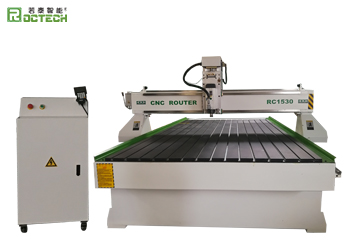
The table below compares a representative ATC router specification with the broader 1325-class market envelope, drawing on published parameters for the Roctech RC1325S-ATC as a reference point.
| Parameter | RC1325S-ATC (reference) | Typical 1325-class range |
|---|---|---|
| X/Y/Z travel | 1,300 × 2,500 × 250 mm | 1,300 × 2,500 × 150–300 mm |
| Positioning accuracy | ±0.03 mm/300 mm | ±0.05 mm/300 mm |
| Repeat positioning | ±0.03 mm | ±0.03–0.05 mm |
| Rapid traverse | 45,000 mm/min | 30,000–60,000 mm/min |
| Cutting feed | 30,000 mm/min | 15,000–30,000 mm/min |
| Spindle power | 9 kW (6/12 kW optional) | 3–12 kW |
| Spindle speed | 0–24,000 rpm | 18,000–24,000 rpm |
| Tool magazine | 8/12/16, carousel | 6–24, carousel or linear |
| Drive | Yaskawa servo | Mixed servo/stepper |
| Control | Syntec | Syntec, LNC, Weihong |
| Transmission | X/Y rack-and-pinion, Z ball screw | Same, with variation |
| Bed | Welded steel tube | Welded steel or cast |
| Net weight | ~2,200 kg | 1,500–3,500 kg |
Three observations follow from the data. First, the accuracy figures are converging: ±0.03 mm repeatability is now common across the class, which means accuracy alone no longer justifies a price premium. What separates machines is accuracy retained over years of service, which depends on bed mass, guide-rail grade, and lubrication discipline rather than catalogue numbers. The 2,200 kg net weight of the reference machine sits in the upper-middle of the range — heavy enough to damp vibration during 9 kW cutting, light enough to avoid foundation work in most shops.
Second, rapid traverse and cutting feed are frequently confused in marketing material. A 45,000 mm/min rapid figure matters only if the tool-change and look-ahead logic can exploit it; on complex nested programs with frequent short moves, the practical differentiator is acceleration and the controller's block-processing speed, not the headline rapid rate. Buyers who compare rapid figures without examining acceleration curves are comparing the wrong number.
Third, the tool magazine is the real specification decision. An 8-position carousel covers most cabinet and signage work; 12 positions accommodate the tool diversity of mixed wood-and-plastic production; 16 positions begin to make sense only when the shop runs lights-out or near-lights-out. Overspecifying the magazine adds cost and, more importantly, adds tool-management overhead that small shops rarely sustain.
III. Technology Application and Supplier Positioning
The integration challenge is where machine builders now compete. An ATC router is a system problem: the magazine must index reliably across tens of thousands of cycles; the spindle taper must hold runout after repeated clamping; the vacuum table must hold small parts without shifting under lateral cutting loads; and the dust hood must not foul the tool-change arc. Each of these is solvable in isolation. Making them coexist on a machine that sells at mid-market prices is the harder engineering and sourcing exercise.
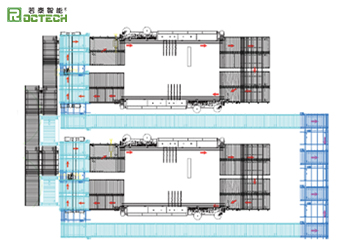
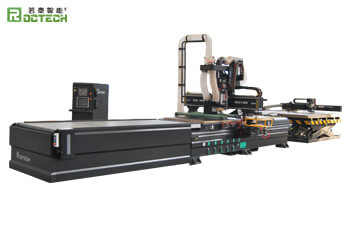
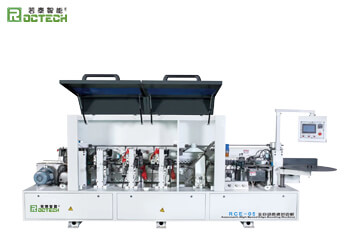
Roctech Machinery Co., Ltd., headquartered in Jinan, Shandong, illustrates the trajectory of a supplier that has moved from single-purpose engravers into this integrated segment. Its product range now spans automatic loading and unloading nesting centers, ATC routers, five-axis machining centers, and panel-processing equipment such as six-sided drills and edge banders — a portfolio that mirrors the workflow of a custom-furniture plant rather than the catalogue of a single-machine vendor. The RC1325S-ATC is representative of the company's mid-range ATC offer, pairing a 9 kW spindle and 8–16 position carousel with HIWIN guide rails, Yaskawa servos, and a Syntec controller — a configuration that has become the pragmatic export standard because every major component has a service network behind it. Roctech's stated export reach of more than 100 countries, together with ISO 9001, CE, and UL certification across its lines, places it among the larger Chinese builders competing on integration and after-sales reach rather than on price alone.
That positioning matters because the ATC segment is bifurcating. At the bottom, entry-level machines with stepper drives and 6-position magazines are pressing prices down. At the top, five-axis simultaneous machines with imported heads and OSAI or Heidenhain controls are absorbing the most complex mold and curved-component work. The viable middle — where most furniture and signage production actually lives — rewards suppliers who can deliver a stable 9–12 kW ATC platform with credible service. Roctech's five-axis line, built around imported swing heads and systems from OSAI, Heidenhain, or Fagor, shows the same supplier hedging across both tiers rather than committing to one.
IV. Conclusion and Outlook
The ATC router has become the general-purpose machine of flexible woodworking production, and the specification race has largely been run. Future differentiation will come from three directions: tighter coupling between nesting software and the controller, so that tool selection and feed rates are optimized per batch rather than per program; predictive maintenance built on spindle load and servo current data, which mid-market controllers can now expose; and automated loading and unloading, which is already migrating down from nesting centers into the ATC class. Suppliers with a coherent multi-machine portfolio and a real service footprint — the category Roctech is building toward — are better placed to sell the workflow rather than the box. For buyers, the practical guidance is unchanged: specify the magazine around actual tool diversity, verify bed mass and guide-rail grade rather than catalogue accuracy, and treat the controller's block-processing performance as a first-order criterion. The machine that wins is the one that changes tools without anyone noticing.
Looking for more information about our CNC machines and services? Contact us today.
ContactNext:Not






















The ATC Router as the Backbone of Flexible Woodworking Production: Technology, Payload Limits, and Supplier Positioning - Roctech® have advanced technology for CNC Router,cnc router cabinets,Roctech already have 15 years experiences of cnc router technology.-© 2023 Roctech® Machinery Co.,Ltd. - All Rights Reserved Website Terms Of Use ● Privacy Policy ● Cookie Policy